The Average Cost of Adoption: What Families Should Actually Expect

The average cost of adoption in the United States typically ranges from $40,000 to $85,000 for a successful private domestic adoption.
That number helps families begin planning. But averages alone do not explain how adoption costs behave over time, why some families exceed that range, or how to prepare a budget for completion.
This guide explains what the average really represents and how to prepare realistically.
Want to talk more specifically about determining a budget? Feel free to reach out today. We also encourage you to dive a little deeper into understanding adoption costs here.
Why Families Ask About the Average Cost of Adoption
Most families are not searching for the cheapest way to adopt. They are trying to answer a practical question:
"What should we realistically prepare for?"
The average cost of adoption feels like a reasonable starting point for budgeting. It helps families determine whether adoption may be financially possible and what level of preparation is required.
The problem is that averages only tell part of the story.
What the “Average Cost of Adoption” Really Represents
In most cases, the average cost of adoption reflects completed adoptions. These figures are typically based on situations where the adoption moves forward without major delays, failed matches, or repeated expenses.
What is often not included in average cost figures is:

This does not make the average inaccurate. It makes it incomplete without understanding how adoption unfolds for many families.
What Families Should Expect to Pay for a Successful Adoption
Across the United States, successful private domestic adoptions typically fall within an average range of $40,000 to $85,000.
This range reflects the real costs required to complete adoption responsibly, including:
- Legal oversight and coordination across states and jurisdictions.
- Medical care and counseling.
- Licensed professional services.
- Marketing and outreach to create adoption opportunities.
Families who complete adoption almost always do so within this range. The difference is not whether these costs exist, but whether families are prepared for them from the beginning.
Lower estimates often assume best-case scenarios or exclude costs that many families eventually encounter.
How Cost Structure Determines Whether the Average Holds
Two families can begin adoption with the same estimated average cost.
One completes adoption within that range. The other spends significantly more.
The difference often comes down to cost structure.
When fees repeat, when families absorb the full financial impact of failed matches, or when services are limited to keep upfront numbers low, the average becomes difficult to maintain.
We calls these "iceberg costs"
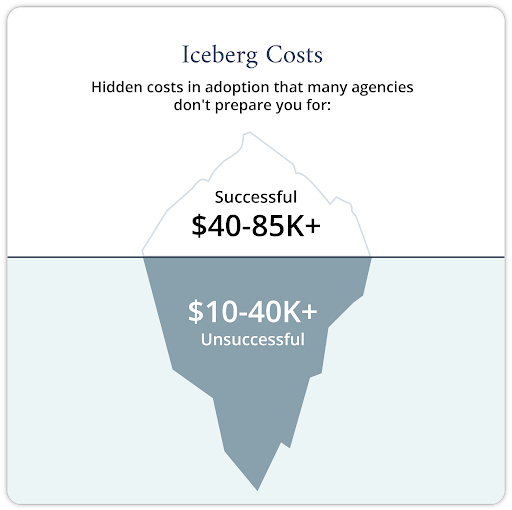
Understanding how costs behave when something does not go as planned is just as important as knowing the estimate itself.
How Budget Affects Adoption Opportunities and Wait Times
Many families aim for the lowest end of the average adoption cost range. That is understandable.
What families often overlook is that the lowest end of the range is also where the largest number of waiting families tend to compete.
When many families are limited to the same budget range:
- Fewer adoption situations are available.
- Competition increases.
- Wait times often become longer.
Families who are able to prepare for a higher budget range are often considered for a wider variety of adoption opportunities and face less competition overall.
A higher budget does not guarantee a faster adoption, but it often provides greater flexibility, more access, and fewer constraints that can slow the process down.
How Families Should Budget Instead of Relying on an “Average”
Rather than planning strictly around an average number, families are often better served by budgeting for:
- variability in adoption situations
- the possibility of delays or disruptions
- the ability to continue moving forward if circumstances change
This approach helps families remain financially prepared and reduces the risk of having to pause or restart the process unexpectedly.
How to Use the Average Cost Wisely
The average cost of adoption is most helpful when treated as a starting point, not a promise.
Families can use average cost information wisely by asking:
- What does this estimate include and exclude?
- Which costs repeat if an adoption does not proceed?
- Who carries the financial risk if something goes wrong?
- How many families actually complete adoption within this range?
These questions help families move from abstract averages to informed planning.
Learn How Adoption Costs Really Work
Many agencies quote the low end of the average cost range, or even below it, to appear more affordable. In doing so, they often leave out costs that families eventually have to pay to complete the adoption.
This is one of the most common reasons families feel financially unprepared later in the process.
To understand how adoption costs actually work, what is often left out of low estimates, and how families can protect their budget, read our complete adoption costs guide.
Disclaimer
Information available through these links is the sole property of the companies and organizations listed therein. American Adoptions provides this information as a courtesy and is in no way responsible for its content or accuracy.