

The Cost of Adopting
5 Questions About Adoption Costs (and the 3 Questions That Everyone Should Be Asking)
When families begin researching the cost of adopting, most are trying to answer one basic question:
"How much will adoption cost, and can we afford it?"
That is a natural place to start.
What many families do not realize at first is that adoption costs are not just about price. It is about the quality of service, financial risk, and where that risk shows up if something does not go as planned.
The 3 Questions Every Family Needs to Ask About Adoption Costs
Most families start by asking about numbers. And while those are important, you need to dig deeper.
Families who get the most from their adoption costs and protect their adoption budget ask these three questions early:
1. What happens financially if a match fails or an adoption disrupts?
2. Which adoption expenses repeat if we have to start over?
3. Which adoption fees are included in this estimate and which ones are not?
These are the three questions that protect your adoption budget.
But they’re rarely the first ones families ask.
The five most common questions are below, and they don’t always reveal what families think they do.
The 5 Questions Most Families Ask About the Cost of Adopting
Most families begin their research with these questions. They are reasonable starting points. But they focus on price, not protection.
1. How much does it cost to adopt?
Private domestic adoption through an agency generally costs between $40,000 and $85,000.
The final number depends on legal work, medical expenses, living expenses, agency services, and outreach efforts.
What this range does not show is how costs are handled if a match fails or whether certain expenses must be paid again if you start over.
2. Why does adoption cost so much?
Adoption involves licensed professionals, legal compliance, screening, counseling, case management, and coordination between multiple parties.
These services require staffing, oversight, and consistent outreach to create adoption opportunities.
When adoption costs fall far below the national range, it often means services are reduced, outsourced, or not fully funded. That can increase delays or disruptions later.
3. What does the adoption fee cover?
Adoption fees usually cover agency coordination, screening, matching, and case management.
Some programs also include marketing outreach and professional support in that fee.
Other expenses, such as birth mother living expenses, medical costs, legal work, or partner agency fees, may be separate. Families should ask for a written breakdown of every category included in the estimate.
4. Can we afford adoption?
Affordability is not just about funding one adoption.
It is about whether your budget can absorb unexpected costs or repeated fees if a match does not move forward.
Many families rely on savings, loans, grants, the adoption tax credit, or fundraising. Before committing, it is important to understand whether your budget protects you from starting over financially.
5. Is there a cheaper way to adopt?
Some professionals advertise lower adoption costs.
Lower pricing can reflect reduced services, limited outreach, smaller staff, or cost structures where families absorb losses after a disruption.
A lower upfront number does not always mean a lower total investment. The structure behind the price determines the real cost.
What’s Missing From the 5 Most Common Questions About Adoption Costs
The five questions above help families understand price, but they do not explain risk.
When families research the cost of adopting, they are often shown only the most visible expenses.
Most adoption cost estimates only show families what’s visible upfront, while the majority of financial risk sits below the surface.
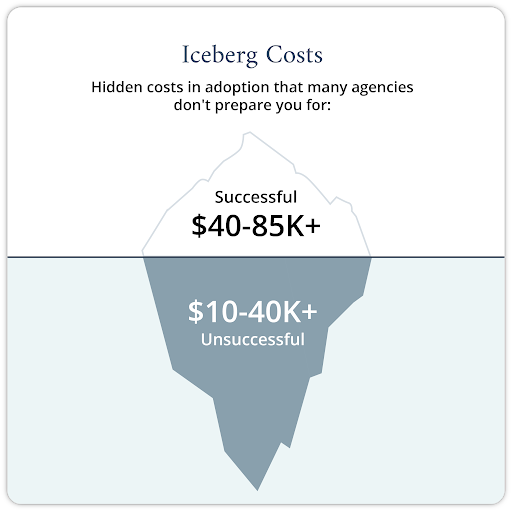
Iceberg costs are real adoption expenses that are rarely included in initial estimates. They often surface when an adoption does not succeed.
The 3 Questions Every Family Needs to Ask About Adoption Costs
Most families start by asking about numbers. But families who protect their adoption budget ask these three questions first:
1. What happens financially if a match fails or an adoption disrupts?
If fees are not protected, families can lose tens of thousands of dollars and must repay major expenses to continue.
2. Which adoption expenses repeat if we have to start over?
Many costs, such as agency fees, legal work, and situation-specific expenses, are charged again with each new opportunity.
3. Which adoption fees are included in this estimate — and which ones are not?
Some estimates exclude medical costs, living expenses, legal fees, or partner agency charges, which can surface later and increase your total cost.
These three questions reveal whether an adoption program is structured to protect your budget or transfer financial risk to you.
The Right Questions Protect Your Adoption and Your Budget
The cost of adopting is not just the number a family is quoted.
It is the financial risk they take on if something goes wrong, and who is responsible for that risk when it does.
Families who ask the right questions early are far more likely to:
- avoid iceberg costs
- protect their adoption budget
- reduce delays and disruptions
- and complete adoption with confidence
See a complete breakdown of adoption costs and how cost structure affects success.
Or, if you prefer, speak with an adoption specialist to walk through how adoption costs apply to your situation and which questions matter most for you.
Disclaimer
Information available through these links is the sole property of the companies and organizations listed therein. American Adoptions provides this information as a courtesy and is in no way responsible for its content or accuracy.